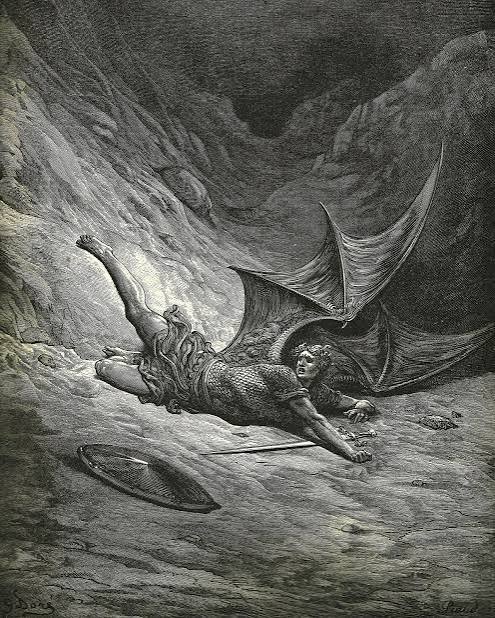
 Modern theistic Satanism refers to contemporary religious currents in which Satan is understood as an independently real deity, spirit, intelligence, or metaphysical presence and is approached through devotion, ritual, prayer, magic, contemplation, or other religious practices. It is part of the wider field of modern Satanism but differs from explicitly non-theistic movements that use Satan primarily as a symbol.[1][2]
There is no single institution that defines modern theistic Satanism. The field includes solitary practitioners, small groups, online communities, devotional churches, demonolators, Luciferian currents, and organizations with their own cosmologies. Some describe themselves simply as Satanists; others prefer terms such as traditional Satanist, spiritual Satanist, demonolator, Luciferian, or Left-hand-path practitioner. These labels overlap imperfectly, so a person’s self-description is generally more informative than assuming that one term fixes all of their beliefs.
A modern religious identity#
Historians distinguish modern self-identified Satanism from the much older accusation that disliked groups secretly worshipped the Devil. Ruben van Luijk describes this distinction through the concepts of attribution and identification: for centuries Satanism existed primarily as something Christians attributed to enemies, whereas modern Satanism emerged when individuals began positively identifying with the previously condemned figure of Satan.[2]
This distinction prevents a common historical error. Medieval heretics, alleged witches, Jews, Freemasons, political radicals, and religious minorities were frequently accused of Satanism, but accusations do not establish religious self-identification. The modern Satanist is historically unusual precisely because the person appropriates a label that had long functioned as a stereotype of absolute religious otherness.
Positive representations of Satan became increasingly visible during the Romantic period. Poets and artists could portray Satan as a rebel against tyranny, a tragic figure, or a symbol of intellectual and political emancipation. Van Luijk argues that this Romantic rehabilitation was a major precondition for the later emergence of religious Satanism.[2] Nineteenth-century occultism, anti-clerical culture, Decadent literature, and esoteric experimentation further widened the range of positive meanings attached to Satan and Lucifer.
Organized Satanism and the question of belief#
The founding of Anton LaVey’s Church of Satan in San Francisco in 1966 is a major landmark in the history of openly organized Satanism. LaVey publicly claimed the name Satanism and created an institution, ritual system, and literature around it. His system, however, was non-theistic: Satan functioned primarily as a symbol of individualism, natural human drives, pride, and opposition to what LaVey viewed as repressive religious morality.[1][2]
The visibility of the Church of Satan created a new reference point for later Satanists, including those who rejected LaVey’s atheism. A major schism in 1975 led Michael Aquino to form the Temple of Set. Scholars often discuss this conflict partly in terms of differing views about supernatural reality and religious authority, although Setian religion should not simply be classified as theistic Satanism; Aquino’s movement developed a distinct identity centered on the Egyptian deity Set.[2]
From the late twentieth century onward, explicitly theistic Satanic identities became more visible through small organizations, occult publishing, correspondence networks, and eventually the internet. Joseph Laycock’s overview of Satanism emphasizes the diversity of contemporary Satanic religions and the difficulty of reducing them to one lineage or theology.[1]
The internet and decentralized religion#
The internet was especially important for modern theistic Satanism because it allowed geographically scattered practitioners to find one another without requiring a large centralized church. Message boards, mailing lists, personal websites, blogs, social media, Discord servers, and private communities have all functioned as places where practitioners exchange theology, ritual methods, reading lists, and personal experiences.
This decentralization has benefits and problems. It allows minority religious identities to develop outside traditional institutions, but it also makes historical claims difficult to evaluate. Online traditions can quickly present recent ideas as ancient, copy unsourced demon lists, or create apparent consensus by repeating material across many websites. For that reason, modern theistic Satanist study benefits from distinguishing primary historical sources, academic scholarship, institutional doctrine, and individual personal gnosis.
The growth of online religion also means that organization size should not be measured only by physical buildings. Some modern Satanist communities are almost entirely digital. The High Satanic Church, for example, describes itself publicly as an independent online congregation for people who believe Satan is real and choose to worship him.[3]
Theology and ontology#
The defining feature of theistic Satanism is not one moral system or ritual style but a claim about reality: Satan is understood as more than a fictional symbol created by humans. What that means varies widely.
Some practitioners are devotional monotheists or henotheists who treat Satan as the central or only deity worthy of worship. Others are polytheistic and place Satan among multiple gods or spirits. Some distinguish Satan from Lucifer, while others identify them. Some work with Lilith or demons as additional spiritual beings. Some describe Satan as an acausal intelligence, a cosmic adversary, a primordial force, an initiator, or a divine consciousness. These theological systems are not interchangeable.
The term “literal Satan” can therefore be too crude. A practitioner may affirm Satan’s independent existence while rejecting the idea that a deity has a physical body located somewhere in ordinary space. Religious language about personhood, spirit, presence, manifestation, and metaphysical reality operates differently across traditions.
Modern theistic Satanists also disagree about Christianity. Some interpret Satan largely through biblical and Christian mythology but reverse the moral judgment. Others see Christian descriptions as hostile propaganda and attempt to develop theology independent of them. Still others use Christian texts as historical material while combining them with occult, pagan, or personal revelation.
Practice#
No universal ritual calendar or liturgy exists. Commonly reported practices include Prayer, Ritual, altars, Offerings, meditation, devotional reading, journaling, sigil work, dream recording, invocations, and the study of Demonology and Grimoires. Some practices are highly ceremonial; others are intentionally simple.
The High Satanic Church’s public practice page provides one example of a contemporary devotional model. It describes quiet direct address to Satan, meditation, ritual for personal or communal occasions, reading, note-taking, and optional use of candles, incense, music, written invocations, or an altar. It explicitly states that no single routine is required.[4] Other organizations or solitary practitioners may prescribe very different methods.
Personal religious experience is especially important in many decentralized theistic traditions. Practitioners may use terms such as personal gnosis, revelation, signs, or spiritual contact. From an encyclopedia perspective, such reports should be described as religious experiences rather than presented as externally verified historical facts. The same distinction is used when documenting mystical experiences in other religions.
Ethics and social life#
Theistic Satanism does not have one ethical code. Some traditions emphasize individual sovereignty, responsibility, consent, loyalty, honor, self-development, or opposition to authoritarianism. Others use more antinomian language and deliberately question conventional moral categories. The presence of transgressive symbolism does not by itself tell us how a practitioner behaves socially.
It is therefore inaccurate to assume that theistic belief in Satan entails criminality or indiscriminate harm. Historical moral panics repeatedly associated Satanism with ritual murder and organized abuse without reliable evidence for the vast conspiracies alleged. Contemporary scholarship treats the “Satanic Panic” of the 1980s and 1990s as a major example of moral panic and conspiratorial accusation.[1]
At the same time, as with any religious or ideological environment, individual Satanists and organizations can be criticized for specific behavior. The correct method is to document actual evidence rather than infer conduct from the Satanist label.
Relationship to symbolic Satanism#
The difference between theistic and symbolic Satanism is often summarized as “belief versus metaphor,” but the boundary can be more complicated. Non-theistic Satanists may use ritual, sacred language, community, ethics, and strong emotional identification with Satan even while denying supernatural existence. Theistic Satanists may also value Satan as a symbol in addition to regarding him as real.
The Church of Satan identifies Satan symbolically and rejects supernatural theism. The Satanic Temple is also non-theistic and has become prominent through religious-liberty litigation and activism. Neither organization represents theistic Satanism. Conversely, the existence of theistic Satanist communities does not make them representatives of all Satanism.[1]
Because the word Satanism covers incompatible positions, comparisons should identify the organization or current being discussed rather than speak of “what Satanists believe” as though the answer were singular.
Diversity and the problem of authority#
Modern theistic Satanism has no pope, universally recognized scripture, or central council. Authority may come from an organization, an individual teacher, a historical text, personal revelation, collective tradition, or some combination. This makes the field difficult to map but also explains its variety.
Claims of ancient secret lineage deserve particular caution. The historical record strongly supports a long history of ideas about Devil worship, but clear evidence for continuous self-identified Satanist institutions stretching unchanged from antiquity or the Middle Ages into the present is lacking.[2] A modern tradition can still be religiously meaningful without pretending to possess an undocumented ancient pedigree.
The result is best understood as a contemporary family of religions shaped by older Jewish and Christian demonology, Romantic literature, occultism, modern individualism, new religious movements, and digital community formation. Modern theistic Satanism is historically recent as an explicit self-identity, but it draws on symbols and questions that are centuries old.
References
- Ruben van Luijk, Children of Lucifer: The Origins of Modern Religious Satanism (Oxford University Press, 2016) — Historical study of attributed and self-identified Satanism and the emergence of modern religious Satanism. (accessed 2026-09-07) ↩
- Per Faxneld and Johan Nilsson (eds.), Satanism: A Reader (Oxford University Press, 2023) — Academic sourcebook and historical overview of Satanic thought and movements. (accessed 2026-09-07) ↩
- Kennet Granholm, “The Left-Hand Path and Post-Satanism: The Temple of Set and the Evolution of Satanism” — Academic discussion of left-hand-path terminology, the Temple of Set, and post-Satanism. (accessed 2026-09-07) ↩
- The High Satanic Church, “About” — Official Church description of its identity and congregation. (accessed 2026-09-07) ↩